Last week one of our founders fished a bass tournament instead of working. It ran the full week, not a single day, and he did not win. What he came back with was a question worth chasing down: how much of a modern fishing operation is actually running on machine learning, and what is the real engineering underneath it?
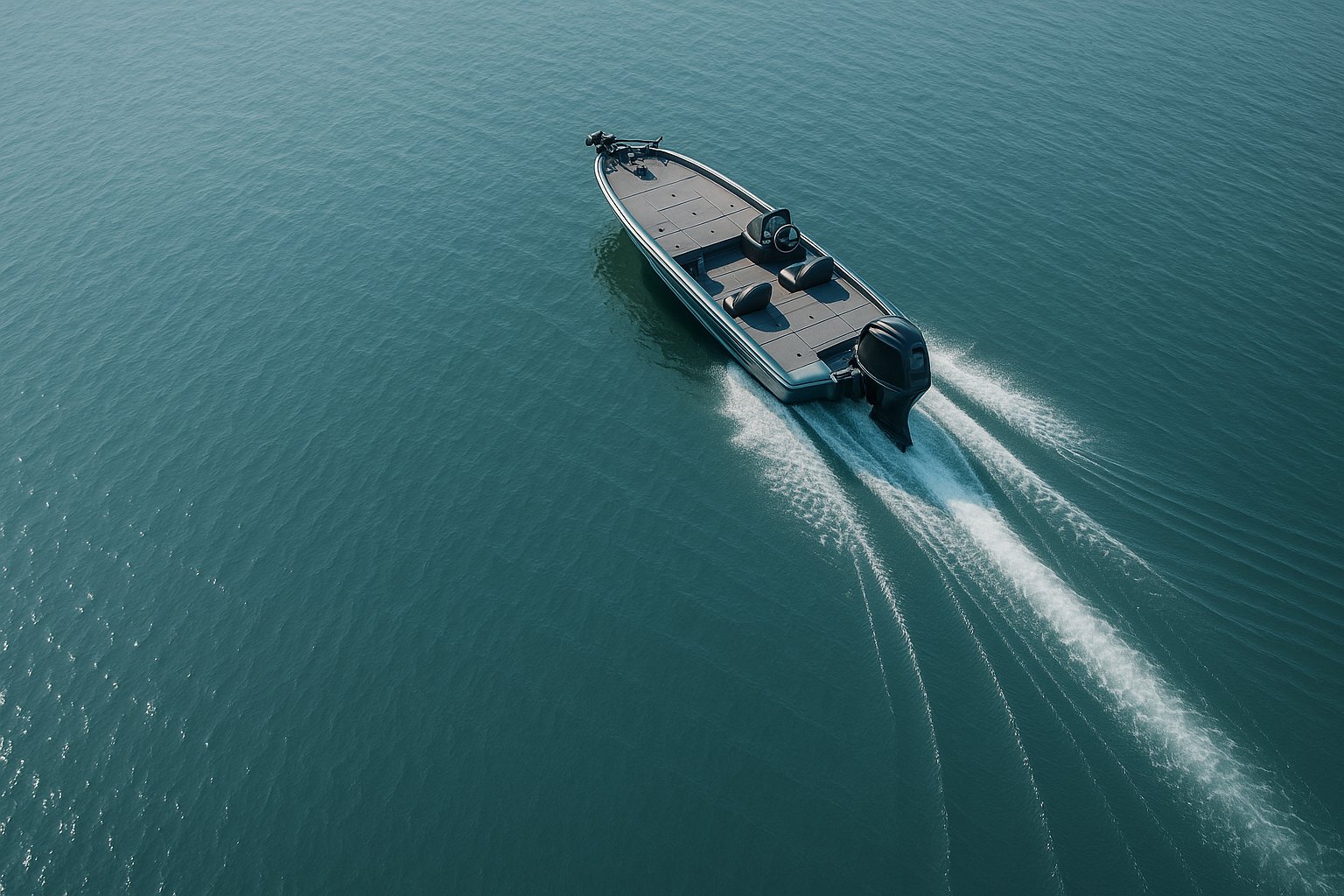
The answer surprised us. A lot of what looks like marketing turns out to sit on well-documented computer vision and time-series models, some of it published, some shipping in products you can buy today. A fair amount of the rest is GPS and control engineering wearing an AI label, which is worth calling out plainly. Below are the places it shows up, from finding fish to the gear in your hand to the boat you tow home, with the actual methods, the products that use them, and where the claims hold up or fall apart. Sources are linked at the end.
Computer vision and time-series
Tree ensembles and neural nets predicting catch, keypoint detection measuring fish, CNNs classifying vessels from their tracks. Published, validated, and shipping.
GPS and control engineering
Spot-Lock, assisted docking, route record-and-retrace. Real, useful automation - precise GPS plus closed-loop control, not learning. Worth calling out plainly.
01Predicting where the fish will be
The consumer version is an app like BassForecast, which pulls AccuWeather data plus solunar tables and barometric trends to score a 10-day window of good and bad bite periods. That end of the market is mostly weighted heuristics and regression on weather features, useful but shallow.
The research and commercial end is more interesting. The classic approach is a Habitat Suitability Index, a model that maps environmental conditions to a suitability score from 0 to 1 for a given species. Statistical work moved on to Generalized Additive Models and maximum-entropy (MaxEnt) models, both fitting catch per unit effort, or CPUE, as the response variable. The current generation uses tree ensembles and neural nets. A 2023 study mapping potential fishing zones for Indian mackerel off Malaysia trained a random forest on 2,535 samples and validated it against 1,087, reaching a Lin's concordance of 0.811 between predicted and observed CPUE. Its variable-importance ranking put sea surface height anomaly first, then eddy kinetic energy, sea surface temperature, and surface chlorophyll-a. A separate yellowfin tuna study compared sixteen regressors, found LightGBM and Extremely Randomized Trees on top, then used SHAP values to explain which environmental drivers carried the prediction, which is the part stock managers actually need.
The common inputs across this literature are remote-sensing layers: SST, sea surface height, salinity, dissolved oxygen, chlorophyll-a, and photosynthetically active radiation, gridded at roughly a quarter-degree and matched to vessel tracks. On the commercial side, Iceland's GreenFish feeds decades of catch logs plus satellite data from agencies like NASA and ESA into models that push hotspot forecasts out about eight days. The limitation is structural, not something a better model fixes: these systems only know what their training data has seen, so they perform on well-logged stocks and fail in data-poor waters.
02Forward-facing sonar, and the AI starting to read it
Forward-facing sonar is the biggest change in competitive bass fishing in a decade. The three systems that matter are Garmin LiveScope Plus (built on the Panoptix platform), Lowrance ActiveTarget 2, and Humminbird MEGA Live 2. The transducer usually rides on the trolling-motor shaft and projects a live beam ahead of the boat rather than straight down, so you watch fish move and react to a lure in real time. The two specs that separate good units from great ones are refresh rate and target separation, the minimum distance at which two returns still resolve as two objects.
Most of what forward-facing sonar does today is signal processing and display, not AI. The recognition layer is still the angler's eyes. The genuine machine learning is showing up first offshore, where the budgets are higher.
Furuno's DFF3D multibeam sonar sweeps a 120-degree swath and, paired with TimeZero software, runs target classification that separates bait species from clutter. Higher-end offshore stacks combine that return with bathymetry and current models to predict where flow concentrates bait, and overlay oceanographic products like ROFFS or Hilton's. Automatic species-and-size labeling on a consumer FFS screen is being promised by manufacturers but is not really here yet.
The fairness fight shapes what gets built. B.A.S.S. limited forward-facing sonar to 5 of its 9 events in 2026, with use decided by a coin flip at each tournament, and the National Professional Fishing League banned it outright for 2025. Whatever AI guidance arrives next inherits that same argument about whether it is a tool or a crutch.
03The tournament that scores itself
The event our founder fished ran entirely through a catch-photo-release app, which is now standard at the grassroots level. Platforms like FishDonkey, Weighfish, Fishing Chaos, and iAngler handle registration and payment, then take a time-stamped, often geotagged photo of each fish on a bump board, log the length, and run live leaderboards that auto-cull each angler down to their best qualifying fish. The anti-cheat layer leans on photo metadata: capture timestamps, location, and checks that an entry was not submitted before the start whistle or after the cutoff.
The newer work removes the bump board. A company called TUUL.AI built FishScore around mobile augmented reality and the LiDAR sensor on recent iPhones, running fish segmentation on-device and fully offline to reconstruct the fish and measure it without a reference object in the frame. It captures area and overall size, not only length, which opens up species-weighted scoring. AINGLER is going a similar direction, with a scoring system it calls FishScore and an auto-entry model that drops any eligible catch into every tournament you qualify for without manual sign-up. Under the hood this is the standard vision stack: object detection to find the fish, instance segmentation or keypoint detection to trace it, and depth from LiDAR or stereo to turn pixels into inches.
04Measuring a fish without touching it
This deserves its own section because it is the most technically mature piece, and the methods are specific.
The naive approach segments the fish and takes the longest axis of the mask as its length. That breaks the moment the fish bends or turns, because the contour stops mapping cleanly to a straight body length. The field moved to keypoint detection instead: train a model to find anatomical landmarks, usually the snout and the tail fork, and measure between them.
Detect the fish
Object detection finds the fish in the frame - YOLO, Keypoint R-CNN and friends.
Find the landmarks
Keypoint detection traces the snout and the tail fork, robust to a fish that bends or turns.
Add depth
LiDAR or a stereo rig turns pixels into real distance, with explicit refraction correction underwater.
Length and mass
Head-to-tail distance becomes centimeters; a regressor maps dimensions to weight.
The architectures in current papers are Keypoint R-CNN, the RTMDet plus RTMPose pair, and pose variants of YOLOv8 and YOLOv11. A 2025 model called FishKP-YOLOv11 reports 91.8% mAP50 on detection and 91.7% on keypoint localization for grass carp in messy farm water, then feeds those points into a random forest that maps body dimensions to mass.
Turning pixels into a real measurement is where the difficulty lives. One route is monocular: estimate per-pixel depth with a network like GLPN, combine it with the camera's focal length, and convert the head-to-tail pixel distance to centimeters. The other route is a binocular or stereo rig that reconstructs 3D coordinates directly. Both have to handle refraction underwater, where the water-glass-air interface introduces coordinate errors reported between 3.8 and 12.4 percent, so the better systems build an explicit refraction correction into the calibration. A simpler binocular keypoint study from 2023 logged about 85% keypoint accuracy and roughly 7% length error in a pool, a fair benchmark for how good cheap setups get.
On the consumer side, onWater shipped an AI trout-measuring tool that identifies 107 species and returns a length from a single photo with no ruler or hand for scale. The conservation angle is real: less handling means lower stress and better post-release survival, and the same logging captures kept-versus-released data that agencies can use. At fixed monitoring sites, systems like the Simsonar Fish Counter use a stereo 3D camera in a video tunnel to measure and identify passing fish, with the older VAKI Riverwatcher and its infrared silhouettes as the validation baseline. Training the classifier to confidently add a new species takes on the order of a thousand labeled passes.
05The gear in your hand: lures, tackle, and rods
There are two buckets here, and the flashier one is mostly early.
Smart lures are the flashy bucket. SmartLure's Model Zero packs sensors into a hard bait to log depth, temperature, and motion over Bluetooth, and the team has used that data to prototype a hook aimed at reducing post-release mortality. Robotic and biomimetic lures that supposedly read a follow and change their action to trigger a strike exist mostly as prototypes and concept demos. The copy about a lure that "learns a fish's preferences" is aspiration, not a thing you can buy and trust today.
The concrete use is design, not the lure in the water. Tackle.net built an AI Lure Generator on Stable Diffusion that turns a prompt into custom bait concepts, aimed at the small-batch and collector market where 3D printing makes one-off baits viable. Hobbyists have hand-built physical lures from diffusion-model images and caught fish on them, which is a fun proof that generated geometry works even when it looks strange. Offshore, there is a genuine data loop around trolling spreads: some systems point high-frame-rate stabilized cameras at the wake and run machine learning trained to recognize lure types, positions, and movement, then correlate spread geometry and boat speed against hookups across many trips. That is pattern mining on your own catch log, and its value grows with sample size. For a bass angler the equivalent is your app's catch history feeding spot and lure suggestions, the same idea at smaller scale. Rods are the least touched of all. The "AI-powered rod" language is mostly about composite layup and sensors, not learning.
06The boat under you: hull design
This is where generative design is furthest along, with one caveat: most of the published work targets ships, not bass boats, though the methods scale down.
Hull design is fundamentally a drag problem, and running computational fluid dynamics on every candidate shape is slow. The fix is a surrogate model: train a network to predict hydrodynamic resistance straight from hull geometry, so you can search thousands of shapes without simulating each one. One representative approach encodes hulls with a Variational Autoencoder paired with a hydro-predictor, learning the relationship between a Laplacian-parameterized hull and its CFD-simulated drag, then optimizing inside that latent space. The authors augment a single parent hull into a full training set using Perlin-noise mapping and Free-Form Deformation, and report under 4% average error on total resistance prediction. Since hull form drives roughly 70% of a vessel's cost, that speedup is the whole point.
Generative models go further than prediction. ShipGen is a diffusion model that produces parametric hull forms under multiple objectives and constraints. Other work trains a Gaussian Mixture Model on SHIP-D, a dataset of 30,000 hull forms, to sample new designs. The frontier is hybrids that constrain a generator with naval-architecture rules so every shape it proposes is already stable and class-compliant, plus reinforcement learning that treats hull generation as a sequential decision problem. Industry consortia like AI4TwinShip wire the loop together: HELYX CFD generates the data, an ML package trains on it, and RBF mesh morphing parameterizes the hull so the whole thing runs close to real time.
The caveat for a bass boat specifically: these are big-ship and superyacht tools. A bass-boat builder benefits from the same CFD surrogates and generative search, but public, bass-boat-specific examples are thin. Most of the visible AI on a new bass boat lives in the electronics and the propulsion, not yet in the hull mold.
07The propulsion: motors, docking, and upkeep
It is worth separating real autonomy from real machine learning, because the two get blurred in the marketing.
The trolling motor is the autonomy story, and it is genuine. Minn Kota's i-Pilot, now rebranded Advanced GPS, and Garmin's Force run GPS Spot-Lock, which holds the boat on a fixed point against wind and current, plus heading hold, route record-and-retrace, and depth-contour following when networked to a fish finder over the One Boat Network or a Garmin chartplotter. This is precise GPS plus closed-loop control, not learning, but it is real automation, and it reshaped bass fishing more than almost anything since the depth finder. Budget systems like AutoBoat clamp similar Spot-Lock onto a transom motor for a fraction of the price, holding position to within a few meters.
The big-engine makers push autonomy further. Volvo Penta's Assisted Docking fuses its GPS Dynamic Positioning with the IPS pod drives and joystick control to compensate for wind and current while docking, automating the captain's intent rather than fully self-docking. That is sensor fusion and control engineering. The machine learning tends to show up in upkeep instead: connected platforms enable predictive maintenance and remote diagnostics, and Volvo's own research has used LSTM models to predict component failure from sensor streams. Engine design itself increasingly leans on ML surrogates, and there is early work on performance-to-design generation for marine propellers, learning a direct map from desired performance to blade geometry rather than looping CFD by hand.
08The same toolkit, scaled up to the ocean
Step away from the lake and these same techniques run the back end of global fisheries.
Vessel tracking is the clearest case. Global Fishing Watch processes tens of billions of AIS position messages through two convolutional neural networks. These are 1D CNNs that convolve along the time axis of a vessel's track rather than across an image. The first, the vessel-characterization model, sorts a boat into one of dozens of classes and predicts its length, tonnage, and engine power, validated at around 95% accuracy against known registries. The second scores every individual AIS position as fishing or not fishing, trained on more than a thousand hand-labeled tracks. The foundational paper is Kroodsma et al. 2018 in Science. For boats that switch off their transponders, the so-called dark vessels, detection shifts to synthetic-aperture radar and nighttime VIIRS imagery, which is what the Defense Innovation Unit's xView3 challenge was built to advance.
On the boats themselves, electronic monitoring replaces or supplements human observers with cameras. NOAA Fisheries runs fourteen EM programs in US waters, and the single largest cost in all of them is manual video review plus data transmission and storage. The open-source answer is VIAME (Video and Image Analytics for Marine Environments), built by Kitware on its KWIVER toolkit. It is a pipelined system chaining stereo matching, object detection, object tracking, and classification, and it is in production for the CamTrawl pollock survey, the HabCam scallop survey, the MOUSS bottomfish survey, and even counting seals from aerial photos. At the Alaska Fisheries Science Center, the longline work detects and identifies fish at the rail, measures length off the fish midline, and counts halibut bycatch, improving through an active-learning loop where technicians correct the model's misses.
Fish farming may be the deepest deployment of all. The camera-based biomass-estimation market was about $312 million in 2024, with OptoScale, Aquabyte, AKVA Group, Imenco, and others selling underwater stereo-camera systems. One published setup pairs a custom YOLOv5 variant with stereo vision and reports a 2.87% mean relative error and an R-squared of 0.98 on fish dimensions. The output feeds two loops: a biomass histogram that sets the next feeding amount and sends an instruction to the feeder, and a health classifier that flags disease or abnormal behavior early.
A note on what is actually shipping
The pattern that stuck with our founder is the lag. The heaviest, most validated machine learning is running quietly in fisheries science and fish farms, where someone can justify a stereo rig and a labeled dataset. The consumer gear is a step behind: forward-facing sonar still leans on the angler to read the screen, the trolling motor is brilliant control engineering rather than learning, and on-device measuring is the newest piece to actually work.
The gap is closing, and bass fishing happens to be where a lot of recreational anglers meet it first. At the end of the week he did not towel off and drive home. He winched the boat onto the trailer and hauled it out of the lake, still chewing on how much of that rig had been doing the math for him.
“The heaviest, most validated machine learning runs quietly where someone can justify a stereo rig and a labeled dataset. The consumer gear is always a step behind - and the gap is closing.
References
- Random forest mapping of potential fishing zones for Indian mackerel (CPUE, predictor ranking) - ScienceDirect
- LightGBM as optimal model for yellowfin tuna distribution, with SHAP analysis - PMC
- Improving fishing ground estimation with weak supervision and meta-learning - PMC
- Garmin LiveScope: how forward-facing sonar works - Wired2Fish
- AI offshore fishing: Furuno DFF3D target classification and ML trolling-spread analysis - In The Spread
- Forward-facing sonar buyer's guide and 2026 tournament rules (B.A.S.S., NPFL) - findingDulcinea
- FishScore: AR and LiDAR on-device fish measurement - TUUL.AI
- AINGLER AI tournament platform and FishScore scoring - AINGLER
- FishDonkey catch-photo-release tournament app - App Store
- FishKP-YOLOv11 keypoint model for fish size and mass (91.8% / 91.7% mAP50) - MDPI Animals
- Underwater keypoint phenotype measurement using RTMDet and RTMPose, with refraction correction - Scientific Reports
- Keypoint detection for fish size measurement, binocular reconstruction (85.1% accuracy) - IET Image Processing
- Tilapia feeding system using YOLOv8 keypoints plus GLPN depth estimation - arXiv
- onWater AI trout measuring tool (107 species, conservation logging) - Bass Angler Magazine
- Simsonar Fish Counter stereo 3D camera and VAKI Riverwatcher comparison - FISHBIO
- Tackle.net AI Lure Generator built on Stable Diffusion - EIN Presswire
- SmartLure Model Zero, sensor-equipped smart lure - Ocean Blue Fishing
- AI in Ship Design: a state-of-the-art review (VAE plus hydro-predictor, under 4% resistance error) - ResearchGate
- ShipGen: a diffusion model for parametric ship hull generation with constraints - arXiv
- Ship-D: ship hull dataset of 30,000 forms for ML design optimization - arXiv
- AI4TwinShip: real-time hull design with HELYX CFD, ML training, and RBF mesh morphing - ENGYS
- AI-driven performance-to-design generation for marine propellers - arXiv
- Minn Kota Advanced GPS and i-Pilot Spot-Lock overview - TrollingMotors.net
- Garmin Force trolling motor with built-in autopilot - Garmin
- Volvo Penta Assisted Docking, GPS Dynamic Positioning plus IPS - Volvo Group
- Volvo Penta IPS Professional Platform, predictive maintenance and remote diagnostics - Business Wire
- Global Fishing Watch: two CNN models on AIS data - Global Fishing Watch
- Global Fishing Watch methodology: 1D CNNs and 95% vessel classification accuracy - Medium
- NOAA Fisheries: electronic monitoring and machine vision overview - NOAA Fisheries
- VIAME (Video and Image Analytics for Marine Environments) - Kitware
- NOAA EM computer vision systems for Alaska fisheries (rail detection, length, halibut bycatch) - NOAA repository
- AIoT advances in aquaculture, YOLOv5 plus stereo biomass estimation (2.87% MRE, R-squared 0.98) - Preprints.org
- Aquaculture camera-based biomass estimation market and vendors - Industry report
Telling the real ML from the label is the job
Most "AI" is a mix of genuine machine learning, plain control engineering, and aspiration. We help teams find the part that actually moves the needle and ship it to production. Get a free expert review of your AI idea or roadmap, read by our Chief AI Officer.
Get your free expert report