There's a quiet awkwardness creeping into standups. A developer joins the call and gets the usual question: what did you work on yesterday? The honest answer is more and more often some version of "I told Claude what I wanted and it built most of it, then I reviewed what Codex shipped." So the team spends fifteen minutes discussing the output of tools that don't attend meetings, can't be blocked, and don't need a daily ceremony to coordinate their work.
Fair question, then. Is Scrum dead?
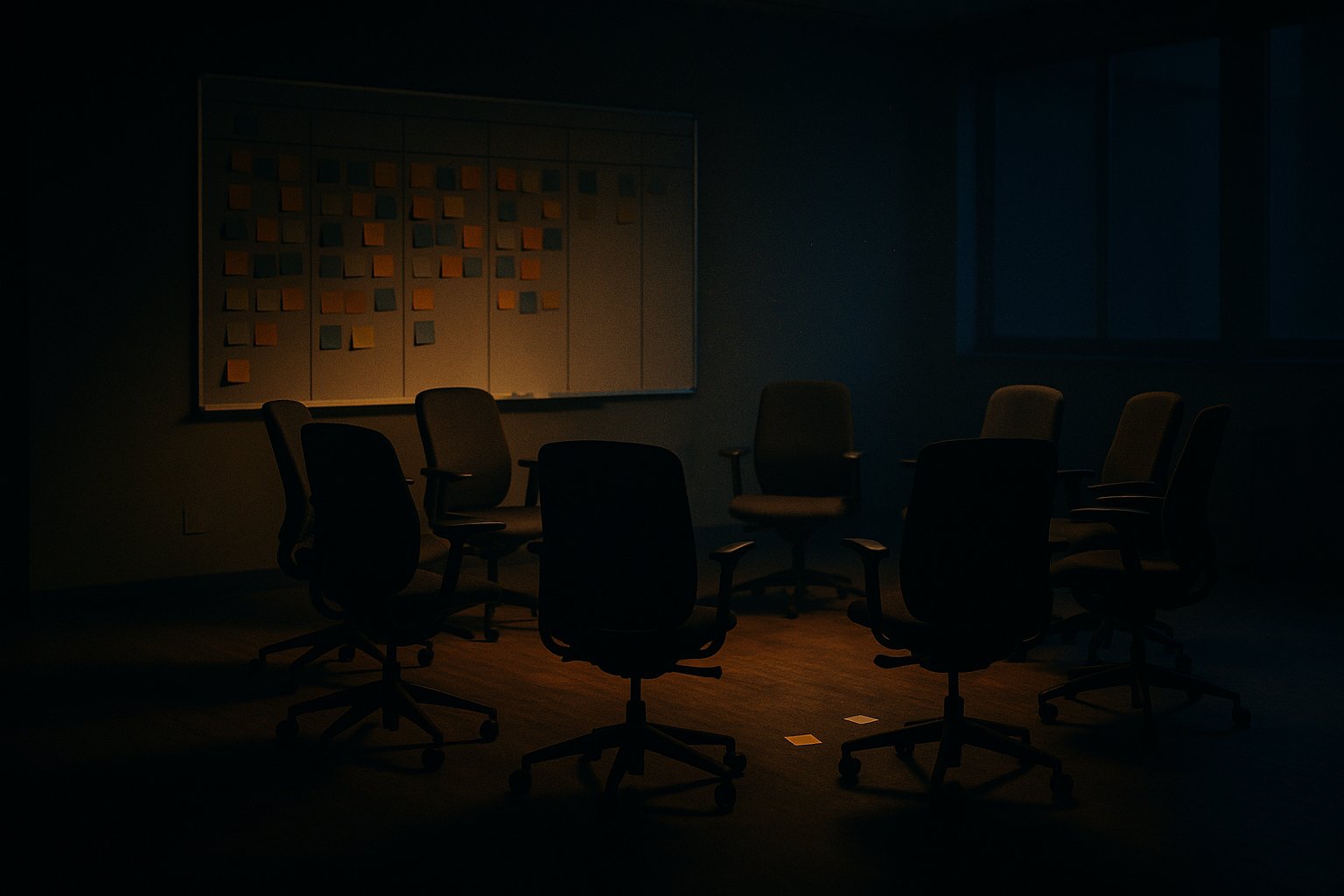
What Scrum was actually for
Scrum came from a world where software got built by people, slowly, with a lot of uncertainty about who was doing what and whether any of it would fit together. The ceremonies existed to catch coordination problems early. When five engineers each spend a week on code that depends on each other, you really do need to know that Alice is stuck waiting on Bob, that the API contract changed, that someone's estimate was way off.
All of that overhead assumed one specific thing was slow and expensive: writing the code. So you coordinated the humans carefully, because their output was the scarce resource.
Every Scrum ceremony was tuned around one premise - that producing code is the slow, scarce, expensive step. Coordinate the humans carefully, because their output is the bottleneck.
What changed
AI coding assistants go straight at that assumption. Producing code is no longer the scarce part. One engineer can now generate, refactor, and ship the kind of volume that used to take a whole team. The "what did you do yesterday" update stops meaning much when the answer is a description of a prompt and a code review.
Producing code
Slow, expensive, done by hand. The thing every ceremony was built to coordinate.
Specifying intent
Getting the right requirement, constraint, and context to the agent doing the building.
When the speed of building jumps by an order of magnitude, the rituals built around slow building start to feel like friction. The daily standup was tuned for a bottleneck that isn't the bottleneck anymore. Sprint planning that carefully sequences two weeks of human effort looks odd when the human effort is mostly specifying and reviewing, and the actual building takes hours.
Narrating yesterday's output
The daily status recap of what got built. Nobody wants to sit in a meeting to narrate what an agent shipped overnight.
Sequencing human keystrokes
Sprint planning that carefully orders two weeks of by-hand coding, when the building now takes hours.
So the parts of Scrum that exist only to manage the mechanics of human coding throughput really are dying. Nobody wants to sit in a meeting to narrate what an agent built.
Coordination didn't disappear, it moved
Here's where "Scrum is dead" goes wrong. It mixes up the ceremonies with the need underneath them. The ceremonies are fading. The need is not.
“What an agent can't do is read the knowledge sitting in your head that nobody wrote down.
It doesn't know the billing system has a strange edge case the finance team cares about. It doesn't know why the last integration with the legacy CRM blew up, or which architectural constraint exists only because of a contract someone signed two years ago. It doesn't know the real business requirement behind the ticket. It only knows the ticket.
The billing edge case
A strange exception the finance team cares about, written down nowhere the agent can read.
Why the last integration blew up
The legacy CRM failure mode that lives only in the memory of whoever was on call that night.
The constraint from a contract
An architectural decision that exists only because of something someone signed two years ago.
The real requirement
The business need behind the ticket. The agent only knows the ticket, not the reason for it.
The bottleneck moved from producing code to specifying intent correctly. And the most valuable intent still lives in people's heads: business requirements, the reality of integrations, architecture decisions, the reasoning behind why things are the way they are. That knowledge is the difference between an agent that builds the right thing and one that builds the wrong thing very fast and very confidently.
An agent with the wrong context does not slow down and ask. It builds the wrong thing very fast and very confidently. The cost of unclear intent went up, not down.
What we believe at Strongly
We don't think all meetings will go away. Trying to kill every ceremony is an overcorrection. Pulling context out of people's heads matters more now than it ever did, but it has to be done in a way that builds a context layer for the agents doing the work, not just a status update for a manager.
That means meetings need to change shape. Instead of recapping what got built yesterday, they should focus on the things still locked in human heads: business requirements, integration constraints, system architecture, the nuances of legacy code and why it behaves the way it does, the reasoning behind decisions.
A status update for a manager
Recaps what got built yesterday. Produces a list of commits and a sense that everyone is busy.
- Narrates output the tools already logged
- Coordinates a bottleneck that moved
- Evaporates the moment it ends
A context layer for the agents
Pulls the knowledge only humans have into a durable, structured form agents can actually use.
- Captures requirements, constraints, and architecture
- Records the reasoning behind decisions
- Feeds the systems now doing the building
A good meeting shouldn't produce a list of yesterday's commits. It should produce durable, structured context that agents can actually use to build the right thing.
“Scrum as a fixed set of daily rituals built for slow human coding is fading. But the deeper purpose - getting the right knowledge to the right place at the right time - is becoming the whole game.
The teams that come out ahead won't be the ones who abolish meetings or cling to the old ceremonies. They'll be the ones who rebuild their meetings around getting the context only humans have and feeding it into the systems now doing the building.
So: is Scrum dead? The daily ritual built for slow human coding is fading. The need underneath it - getting the right context to where the work happens - has never mattered more.
Turn the knowledge in people's heads into context agents can use.
Strongly's forward deployed engineers embed in your operations, capture how your business actually works, and build the context layer that keeps your AI building the right thing - not the wrong thing fast.
Explore the Platform