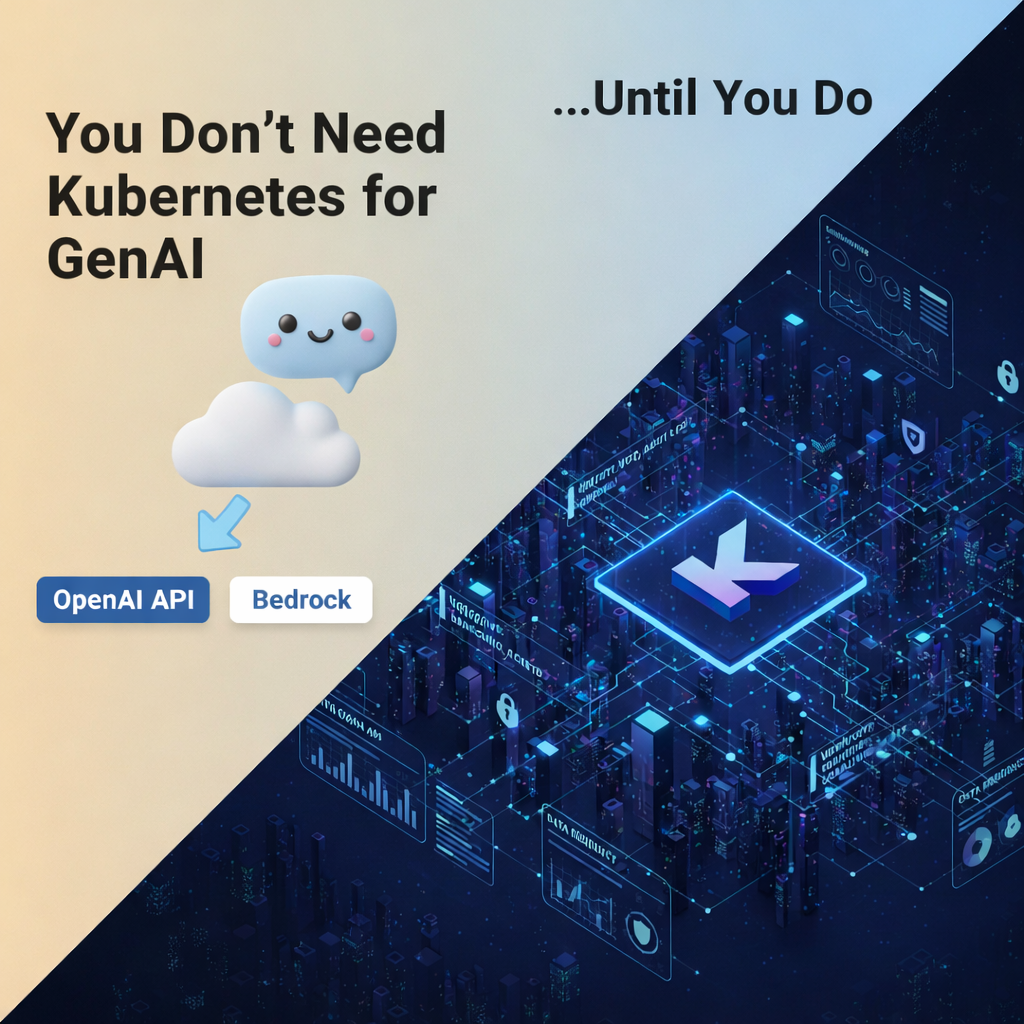
Let me save you some time: if you're building a chatbot prototype or adding a summarization feature to your app, you don't need Kubernetes. Call the OpenAI API. Use Bedrock. Ship it and move on.
Seriously. Kubernetes is complex software, and complexity has costs - hiring, operational overhead, debugging at 2am. If an API call solves your problem, take the win.
But here's what I've watched happen, over and over: a team starts with a simple integration. One model, one prompt, a serverless function to glue it together. It works. Then come the requirements.
Suddenly you're not calling an API anymore. You're building a system. And systems need a platform.
This is the moment where Kubernetes stops being overkill and starts being the obvious choice. Not because it's trendy - but because GenAI workloads have specific properties that K8s handles remarkably well, if you know where to look.
“There is an inflection point where the simplicity of managed APIs becomes a constraint, and the power of Kubernetes becomes a worthwhile trade.
When Security Gets Serious
The prototype phase is forgiving. Data flows through third-party APIs. Everyone shares credentials. It works because the stakes are low.
Then the stakes change.
Security wants to know where customer data goes. Legal needs assurance that sensitive documents never leave your environment. Compliance wants to know who accessed which models, when, and what they did.
These aren't edge cases. They're table stakes for any organization putting GenAI into production.
Managed platforms offer partial answers. Bedrock runs in your AWS account. Azure OpenAI stays in your tenant. But what if the model you need isn't in their catalog? What if you've fine-tuned an open-weights model on proprietary data? What if you need granular access control beyond API key tiers?
Self-hosting on Kubernetes gives you structural control that managed platforms can't. Data residency becomes a guarantee, not a policy. Access control integrates with your existing identity provider. Every request is logged and auditable.
Six Layers of Protection
Kubernetes wraps your GenAI workloads in concentric layers of security, each reinforcing the others:
Workload
Network Policies
Define egress rules at the pod level. Your inference server can't phone home because the network won't allow it.
Private Clusters
Fully private deployments with no public endpoints. Control plane and nodes stay entirely within your VPC.
RBAC & Namespaces
Isolate workloads by team or sensitivity level. Each namespace gets its own access rules and resource quotas.
Identity Integration
Connect to your existing IdP via OIDC. Users authenticate with the same credentials they use everywhere else.
Audit Logging
Every API call is logged. Pair with service mesh telemetry for a complete record of who did what, when.
Admission Controllers
Enforce policies at deploy time. Block unapproved images, require security labels, ensure baseline compliance.
When a Single Prompt Isn't Enough
The first GenAI feature is usually simple. A user sends input, you call a model, you return the response. Maybe you add some prompt engineering. But the core loop is straightforward: input, inference, output.
Then someone asks for something more ambitious.
Now you're not building a feature. You're building a workflow. And increasingly, that workflow looks like an agent.
Agentic AI systems don't just respond - they reason, plan, and act. They call tools, evaluate results, and decide what to do next. They loop until a task is complete. They coordinate with other agents. All of this requires infrastructure that can handle state, branching, parallelism, retries, and human oversight.
You can build this yourself. Teams do it all the time - a growing pile of Lambda functions, some queues, a state machine nobody wants to maintain. It works until it doesn't, and when it breaks, you're debugging distributed systems at 2am with tools that were never designed for the job.
Kubernetes doesn't solve workflow orchestration by itself. But it gives you the foundation - or the platform to run one. The container-native model means each step runs in isolation. The scheduler handles parallelism. The ecosystem provides event-driven triggers, approval gates, and observability.
“This is the difference between "we strung something together" and "we have a platform." When your workflows become agents, you want infrastructure designed for orchestration from the start.
Workflow Orchestration
Multi-step agent pipelines with branching, loops, parallelism, retries, and human approval gates built in.
Tool Isolation
When an agent calls a tool, it runs in its own container with scoped permissions. No cross-contamination.
Event-Driven Triggers
Kick off workflows from webhooks, message queues, file uploads, or agent-to-agent communication.
Massive Parallelism
Fan out to thousands of concurrent tasks. Kubernetes handles scheduling; you define the work.
Guardrails & Oversight
Timeouts, retry limits, approval gates. High-stakes actions require human sign-off before proceeding.
Full Observability
Logs, metrics, and traces for every step. Trace the entire decision path when an agent behaves unexpectedly.
Putting It All Together
Kubernetes is the right answer. But here's the uncomfortable truth: most teams shouldn't be building this infrastructure themselves.
Every hour spent debugging node pools or writing network policies is an hour not spent on the product your customers actually care about.
That's why we built Strongly.ai. We handle the platform so you can focus on what runs on it. Data residency, access control, workflow orchestration, autoscaling - the hard problems we've been talking about - they're solved out of the box. Your team gets self-service GenAI without needing to staff a platform engineering team.
Kubernetes underneath. Complexity abstracted away. Your GenAI workflows in production, not stuck in planning.
The Inflection Point
Let's come back to where we started. If you're building a simple GenAI feature - a single model, a straightforward integration, no compliance requirements - you don't need Kubernetes. Use an API. Ship it.
But that's probably not where you are anymore.
You're dealing with data that can't leave your environment. You're fielding questions about access control and audit logs. You're building workflows that are starting to look like agents with real autonomy and real stakes.
This is the inflection point. The moment where the simplicity of managed services becomes a constraint, and the complexity of Kubernetes becomes a worthwhile trade.
You don't need Kubernetes for GenAI - until you do. And when you do, you'll be glad it's there.
Ready to Move Beyond API Calls?
See how Strongly.ai gives you Kubernetes power without Kubernetes complexity.
Schedule A Demo