Part 1: Foundations
What is RAG?
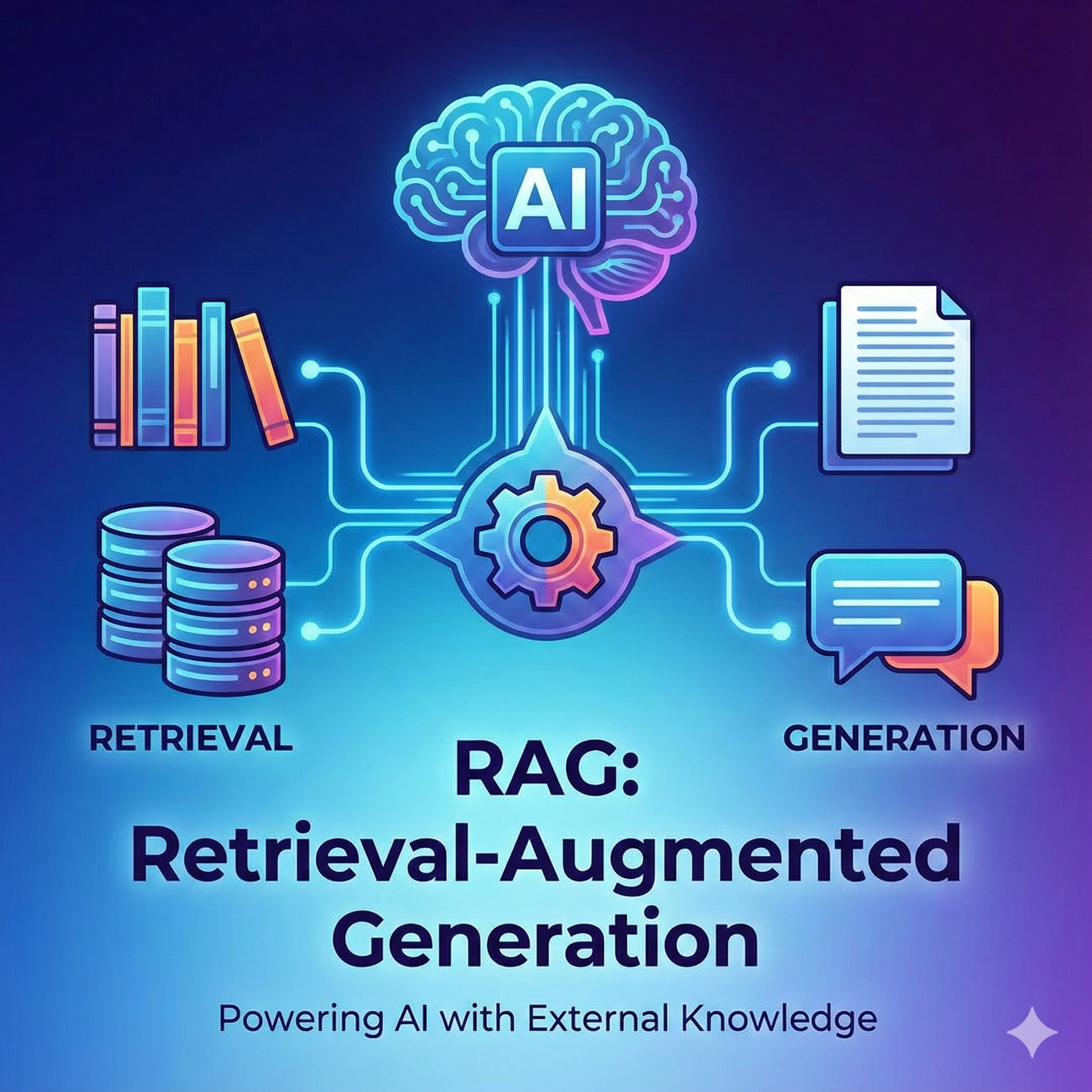
Retrieval-Augmented Generation (RAG) is an architecture pattern that enhances Large Language Models by giving them access to external knowledge. Rather than relying solely on what the model learned during training, RAG retrieves relevant information from a knowledge base and includes it in the prompt. This allows the model to generate responses grounded in specific, up-to-date data rather than just its parametric memory.
The workflow is elegantly simple: a user asks a question, the system searches a knowledge base for relevant documents, that content gets added to the prompt as context, and then the LLM produces a response drawing on both its training and the retrieved information. This simple pattern has become the foundation for most production AI applications that need to work with proprietary or current data.
Why is RAG Needed?
LLMs are remarkably capable, but they have fundamental limitations that RAG directly addresses. The most obvious is the knowledge cutoff problem. Models only know what they learned during training - ask Claude about events after its training cutoff and it simply does not know. RAG solves this by retrieving current information from live data sources, making your AI system as up-to-date as your knowledge base.
Equally important is hallucination reduction. When LLMs encounter questions beyond their knowledge, they often confabulate - producing plausible-sounding but entirely fabricated answers. RAG grounds responses in actual source documents. When the model says "According to your Q3 report, revenue increased 15%," you can verify that claim against the retrieved document. This verifiability transforms AI from an unreliable oracle into a citable research assistant.
Knowledge Cutoff
Models only know what they learned during training. RAG injects live, up-to-date information from your own data sources.
Hallucination Reduction
Grounding responses in retrieved source documents dramatically reduces fabricated answers and enables verification.
Proprietary Data Access
Your customer contracts, internal wikis, and research never existed in training data. RAG bridges this gap at inference time.
No Retraining Required
Unlike fine-tuning, RAG lets you update knowledge by updating your index - no expensive retraining or ML expertise needed.
The Proprietary Data Gap
There is a fundamental asymmetry between what LLMs know and what businesses need. These models are trained on the public internet - Wikipedia, forums, published papers, open-source code. They have never seen your customer contracts, internal wikis, proprietary research, or confidential communications. The information that differentiates your business from competitors simply does not exist in their training data.
Fine-tuning can inject domain knowledge, but it is expensive, requires significant ML expertise, and becomes stale the moment your documents change. RAG offers an elegant alternative: augment generic models with your proprietary data at inference time. Your knowledge base stays separate, easily updateable, and under your control. The model does not need to "learn" your data - it just reads it when relevant.
“RAG offers an elegant alternative to fine-tuning: augment generic models with your proprietary data at inference time. Your knowledge base stays separate, easily updateable, and under your control.
The Context Window Debate
With context windows now reaching 1 million tokens across Claude, Gemini, and GPT-4.1, some question whether RAG remains necessary. The answer requires nuance. Long context windows offer architectural simplicity - you can place entire document collections into a single prompt without building retrieval infrastructure. For small document sets, this approach genuinely works well.
However, RAG maintains significant advantages at scale. It is more cost-effective since you retrieve only what is needed rather than processing millions of tokens per request. It handles rapidly changing data naturally - update your index and you are done, no need to re-run expensive inference. And critically, it provides source citations that long-context approaches struggle to match. Most models also degrade in quality around 130K tokens despite claiming larger windows; Claude 4 Sonnet is notable for showing less than 5% accuracy degradation across its full 200K context, but requests beyond that threshold cost 2x for input tokens. The emerging pattern is to use RAG to intelligently select content for generous context windows, combining both approaches.
The best of both worlds: Use RAG to intelligently select relevant content, then feed it into generous context windows. This combines the precision of retrieval with the comprehension depth of large contexts.
Part 2: Core Components
Embeddings: The Foundation of Semantic Search
Embeddings are the mathematical foundation that makes semantic search possible. They convert text into numerical vectors that capture semantic meaning, placing similar concepts close together in high-dimensional vector space. This enables "semantic search" that finds conceptually related content even without exact keyword matches - searching for "automobile maintenance" will surface documents about "car repair" because the concepts are semantically adjacent.
Traditional embedding models from OpenAI, Cohere, or open-source alternatives like BGE produce dense vectors, typically 384 to 1536 dimensions. These compress all semantic information into a single fixed-length representation. They work well for general-purpose retrieval but can struggle with domain-specific terminology or highly technical content that was not well-represented in training data.
Learned sparse models like SPLADE take a different approach, combining neural understanding with sparse representation. They have shown notably better domain generalization, transferring well to new topics the model was not specifically trained on. Think of them as neural keyword matching - they learn which terms are semantically important while maintaining the interpretability of sparse vectors.
Vector Databases
Once you have embeddings, you need somewhere to store and search them efficiently. Vector databases are purpose-built for this task, enabling fast similarity search across millions or billions of vectors. The landscape has matured significantly, with clear leaders emerging for different use cases.
Pinecone
Dominates the fully-managed enterprise space. Handles billions of vectors with consistent performance and minimal operational overhead.
Weaviate
Appeals to teams needing complex relationship modeling. GraphQL interfaces and built-in hybrid search capabilities.
Qdrant
Written in Rust, earned a reputation for raw performance. Used by Discord and Perplexity in production at massive scale.
Chroma & pgvector
Perfect for prototyping. Chroma offers ~20ms median latency; pgvector adds vector capabilities to existing Postgres.
Start with pgvector or Chroma for prototyping to validate your approach quickly, then migrate to Pinecone or Qdrant when you need production-grade scale and reliability.
Chunking: Preparing Documents for Retrieval
Before embedding documents, you must split them into chunks - and this seemingly mundane step has outsized impact on retrieval quality. Chunk too large and you dilute semantic signal with irrelevant context. Chunk too small and you lose the coherence needed to answer complex questions.
Fixed-size chunking is simple but crude, often breaking mid-sentence or mid-concept. Sentence-based chunking respects natural language boundaries, while paragraph-based approaches preserve more document structure. Semantic chunking, which groups content by topic rather than arbitrary boundaries, produces the highest quality results but requires additional processing and computation.
Don't overlook metadata. Storing source identifiers, section hierarchies, timestamps, and authorship information with each chunk enables powerful filtering and dramatically improves citation quality. Include 10-20% overlap between chunks - typically 50-100 tokens for 500-token chunks - to preserve context at boundaries.
Part 3: Improving Retrieval Quality
Hybrid Search: Best of Both Worlds
Pure semantic search has a weakness: it can miss documents that match on exact keywords but lack semantic similarity. Ask about "Model XR-7500" and semantic search might return documents about similar products rather than the specific model you need. Conversely, pure keyword search (BM25) struggles with synonyms and conceptual queries.
Hybrid search combines both approaches, running keyword and semantic retrieval in parallel, then fusing the results. BM25 excels at exact terms, product SKUs, codes, and proper nouns, while semantic search understands synonyms, concepts, and user intent. Together, they cover each other's weaknesses.
Traditional RAG
Single-pass retrieval
Keyword Search (BM25)
Exact term matching, great for SKUs, codes, and proper nouns.
Dense Embeddings
Single-vector semantic similarity. Good for general queries.
Fixed Chunking
Simple, predictable document splitting with overlap.
Single Retrieval Pass
Retrieve once, generate once. Fast but limited.
Modern RAG
Multi-stage, adaptive retrieval
Hybrid + Reranking
BM25 + semantic fused via RRF, then cross-encoder reranked.
Late Interaction (ColBERT)
Token-level matching preserves fine-grained detail.
Semantic Chunking
Topic-based boundaries with rich metadata and hierarchies.
Agentic Multi-Step
Dynamic retrieval with evaluation, reformulation, and iteration.
The most common fusion method is Reciprocal Rank Fusion (RRF), which computes the reciprocal of each document's rank from both retrievers and sums them. Documents that rank well in both systems rise to the top. Research at CLEF CheckThat! 2025 demonstrated a 23.3 percentage point improvement over baseline when combining BM25, semantic search, and cross-encoder reranking - a striking validation of the hybrid approach.
Rerankers: The Quality Gate
Initial retrieval casts a wide net, typically returning 50-100 potentially relevant documents. But LLMs have limited context windows and attention - you want only the most relevant 5-10 documents in the final prompt. This is where rerankers earn their keep.
Cross-encoders process the query and each document together through a transformer, producing a single relevance score. Unlike embedding models that process query and documents separately, cross-encoders can capture fine-grained interactions between query terms and document content. This makes them significantly more accurate but too slow for initial retrieval over large collections - perfect for reranking a shortlist.
Production options include Cohere Rerank with its multilingual support and 4096-token context, the open-source MS-MARCO MiniLM cross-encoder that remains the most widely deployed, Mixedbread AI's 1.5B parameter model under Apache 2.0 license, and Voyage AI's latency-optimized offerings. Cross-encoder reranking typically improves RAG accuracy by 20-35% while adding 200-500ms latency - a worthwhile tradeoff for most applications.
Late Interaction Models: ColBERT
ColBERT represents a breakthrough in the accuracy-speed tradeoff. Traditional dense embeddings collapse entire documents into single vectors, losing fine-grained information. Cross-encoders preserve this detail but cannot be pre-computed. ColBERT threads the needle: it stores embeddings for each token in the document, then computes token-to-token similarity at query time.
This "late interaction" approach maintains much of the cross-encoder's accuracy while allowing document embeddings to be pre-computed. Jina-ColBERT-v2 extends this with long context support and multilingual capabilities, and notably, reducing dimensions from 128 to 64 cuts storage by 50% with minimal accuracy loss. ColBERT-serve uses memory-mapped indexes to reduce RAM usage by 90%+, enabling deployment on modest hardware.
The Data Parsing Challenge
Before any retrieval optimization matters, you need clean text from messy real-world documents. This is frequently the actual bottleneck - not the sophistication of your retrieval stack but the quality of what goes into it.
PDFs are particularly problematic. Multi-column layouts break naive text extraction. Scanned documents require OCR, which struggles with low resolution, skewed pages, and handwritten annotations. Tables, when converted to plain text, lose the structural information that makes them interpretable. Images and charts contain critical information that text extraction misses entirely.
LlamaParse
Leading solution for complex documents, excelling at converting intricate tables to structured markdown.
Databricks ai_parse
Brings document parsing into SQL workflows, preserving merged cells and auto-generating figure captions.
Unstructured.io
Partitions documents by element type - Title, NarrativeText, Table, Image - for element-specific processing.
ColPali / ColQwen
Vision Language Models that embed documents as images, bypassing OCR and chunking entirely. The frontier.
“The most exciting development is the multimodal approach. Vision Language Models "see" the document and understand layout, tables, and figures directly - bypassing OCR, chunking, and text extraction entirely.
Part 4: Generation
Prompt Engineering for RAG
Two RAG systems with identical retrieval can behave completely differently based on prompt structure. This is where retrieval becomes useful generation - and where many implementations fall short.
System Instructions
Define the model's role and behavior. Set explicit boundaries on what it should and should not do with the retrieved context.
Retrieved Context
Clearly delimit the retrieved documents with markers. The model must know exactly where source material begins and ends.
User Query
Include the original question and any relevant chat history to prevent incoherence in multi-turn conversations.
Missing Info Guidelines
The critical element most miss: explicitly instruct the model to say "I don't have information about this" when the answer is not in the retrieved documents.
Citation Requirements
Require the model to quote directly from sources and attribute claims. This improves accuracy and enables verification.
Query rewriting deserves special attention. Raw user queries are often poorly formulated for retrieval - ambiguous, colloquial, or missing context. Transforming queries before retrieval, either through prompt engineering or a dedicated rewriting model, significantly improves result quality. The user asks "how do I fix that error from yesterday?" and the rewriter expands it to "How to resolve the SSL certificate validation error in the payment processing module that was discussed on November 28th?"
Measure what matters. RAGAS provides metrics for faithfulness, relevance, and recall. The RAG Triad evaluates context relevance, groundedness, and answer relevance. Without systematic evaluation, you are optimizing blind.
Part 5: Advanced Architectures
Knowledge Graphs Meet RAG: GraphRAG
Vector search finds semantically similar content, but it struggles with relationship reasoning. "Who reports to the CEO?" requires understanding organizational structure, not just finding documents that mention the CEO. "What caused the Q2 revenue decline?" demands tracing chains of causation across multiple documents. These are fundamentally graph problems.
Knowledge graphs represent information as entities (nodes) and relationships (edges), enabling queries that traverse connections. "Find all suppliers who provide components used in products sold to customers in Asia" is a straightforward graph query but nearly impossible with vector search alone.
Microsoft's GraphRAG, introduced in 2024, combines both approaches. It uses LLMs to extract entities and relationships from text, builds a knowledge graph with community detection to identify clusters of related entities, generates summaries at multiple abstraction levels, then retrieves using vectors for entry points and graph traversal for relationship-based context. The results are striking: Lettria demonstrated improvement from 50% accuracy with traditional RAG to over 80% with GraphRAG across finance, healthcare, and legal datasets.
Amazon Bedrock introduced managed GraphRAG with Neptune integration in December 2024, making this architecture accessible without building custom infrastructure. For domains with rich entity relationships - organizational data, supply chains, medical knowledge, legal precedent - GraphRAG represents the current state of the art.
The RAG Evolution
RAG has evolved through distinct phases, each building on the last. The trajectory from simple vector lookups to autonomous knowledge agents traces the maturation of an entire discipline.
Basic Vector Search
Dense embeddings + cosine similarity. Single retrieval pass, fixed chunking. The original RAG paper by Facebook AI.
Hybrid Search & Reranking
BM25 + semantic fusion via RRF. Cross-encoder reranking for precision. Chunking strategies mature.
GraphRAG & Knowledge Graphs
Microsoft's GraphRAG combines vector search with entity-relationship traversal. Community detection and multi-level summaries.
Agentic Knowledge Systems
Autonomous agents with dynamic retrieval, query planning, self-evaluation, and multi-source synthesis. Corrective & Self-RAG.
Multimodal & Real-Time RAG
Vision-based document retrieval (VisRAG, ColPali), streaming knowledge graphs, on-device processing, LLM-agnostic platforms.
Agents Building Knowledge Graphs
Constructing knowledge graphs traditionally required expensive manual curation or brittle rule-based extraction. The most exciting development in this space is using multi-agent LLM systems to automatically construct and enrich knowledge graphs from unstructured data.
The KARMA framework (Knowledge Acquisition through Robust Multi-Agent systems) exemplifies this approach. A Central Controller Agent orchestrates specialized workers: Ingestion Agents handle document intake, Entity Extraction Agents identify entities using domain-specific prompts, Relationship Extraction Agents map connections, and Disambiguation Agents resolve conflicts and merge duplicates. Each agent uses specialized prompts and hyperparameters optimized for its task.
The pipeline follows a consistent pattern. LLMs extract Subject-Predicate-Object triples from text chunks. Entity standardization unifies different mentions of the same entity - "AI," "artificial intelligence," and "machine learning systems" might all resolve to a canonical node. Disambiguation handles context-dependent references - "Apple" the company versus "apple" the fruit. The resulting graph gets imported into a graph database like Neo4j, Neptune, or FalkorDB, where agents continuously monitor for new documents and enrich the graph over time.
Organizations report 300-320% ROI with LLM-driven knowledge graphs across finance, healthcare, and manufacturing. Few-shot prompting with models like GPT-4 or Claude achieves accuracy roughly equivalent to fully supervised traditional NER models - without requiring thousands of labeled training examples.
Agentic RAG: Dynamic, Multi-Step Retrieval
Traditional RAG follows a fixed pipeline: retrieve once, generate once. This works for simple factual queries but fails for complex questions that require multiple rounds of information gathering, synthesis across sources, or adaptive strategy based on initial results.
Agentic RAG makes retrieval dynamic. An autonomous agent decides when to retrieve, what sources to query, whether results are sufficient, and whether to reformulate and try again. For "Compare our product roadmap with competitor announcements and identify gaps," an agentic system might first retrieve internal roadmap documents, then query a web search API for competitor news, evaluate the coverage, retrieve additional analyst reports to fill gaps, and finally synthesize across all sources.
Query Planning
Breaking complex questions into sub-queries that can be answered independently and then synthesized.
Tool Selection
Choosing between vector search, graph traversal, web search, and APIs based on the question type.
Result Evaluation
Determining whether retrieved content actually answers the question before proceeding to generation.
Iterative Refinement
Reformulating queries and retrying when initial results are insufficient or conflicting.
Corrective RAG (CRAG)
CRAG introduces quality evaluation directly into the retrieval pipeline. After initial retrieval, a lightweight evaluator assesses document relevance. If retrieved documents are insufficient, the system rewrites the query and tries again or triggers external web search. If documents conflict, conflict resolution agents reconcile discrepancies. Only after this validation does generation proceed.
This approach significantly reduces hallucination by ensuring the model only generates from validated context. It also handles the common case where the user's question cannot be answered from the knowledge base - instead of fabricating an answer, CRAG can explicitly acknowledge the gap or augment with external sources.
Self-RAG
Self-RAG takes a different approach, training models to generate special "reflection" tokens that trigger on-demand retrieval. Unlike traditional RAG that always retrieves regardless of whether it is helpful, Self-RAG retrieves adaptively. For questions the model can confidently answer from training, it skips retrieval entirely. For complex queries, it may retrieve multiple times, evaluate each retrieval, and critique its own generation before producing final output.
“Self-RAG matches how humans actually research: sometimes you know the answer, sometimes you need one source, sometimes you need to check multiple references and reconcile them.
Part 6: The Road Ahead
Emerging Trends
Several developments are reshaping the RAG landscape as we move into 2026. Multimodal RAG is perhaps the most transformative: VisRAG, presented at ICLR 2025, embeds documents as images and retrieves them directly, achieving 20-40% performance gains over text-based RAG. The model "sees" documents rather than reading extracted text, preserving layout, table structure, and visual elements that text extraction loses.
Multimodal RAG
VisRAG and ColPali embed documents as images, achieving 20-40% performance gains by "seeing" layout and structure directly.
Real-Time RAG
Streaming architectures replace weekly index refreshes. Legal, financial, and support AI systems update in seconds.
On-Device RAG
Processing happens locally for privacy-sensitive applications. Indexes and models never leave your security perimeter.
LLM-Agnostic Platforms
Abstracting the model interface lets organizations swap providers as capabilities and pricing evolve.
Real-time RAG systems are emerging that integrate with auto-updating knowledge graphs. Legal AI systems track court rulings as they are published. Financial AI adjusts to market movements within minutes. Customer support AI reflects product updates instantly. The static index that gets refreshed weekly is giving way to streaming architectures that maintain currency measured in seconds.
On-device RAG is gaining traction for privacy-sensitive applications. Rather than sending queries to cloud services, processing happens locally on user devices or in private data centers. Companies increasingly deploy models within their own infrastructure, with RAG indexes that never leave their security perimeter.
Finally, the most successful RAG platforms are becoming LLM-agnostic by design. Rather than coupling tightly to a specific model, they abstract the language model interface, allowing organizations to swap providers as capabilities and pricing evolve. This flexibility has proven essential as the model landscape continues its rapid evolution.
Conclusion
RAG has matured from a simple retrieval pattern into a sophisticated ecosystem of techniques and architectures. The practitioners seeing the highest ROI share common patterns: they start simple, with basic RAG and good chunking, rather than over-engineering from the outset. They invest heavily in data quality, recognizing that parsing and preparation often matter more than retrieval sophistication. They add hybrid search and reranking early, as these deliver the highest impact per unit of effort. They introduce knowledge graphs for relationship-heavy domains and agentic patterns for complex queries - but incrementally, validating value at each step.
The organizations achieving the highest returns treat RAG as a system to be engineered rather than a pattern to be implemented. They measure faithfulness, relevance, and user satisfaction. They iterate based on failure cases. They recognize that the field continues to evolve rapidly - what is advanced today becomes table stakes tomorrow. Start with the fundamentals, master them, and layer on advanced techniques as your use cases demand.
References
- Anthropic. (2024). "Building Effective Agents".
- Microsoft Research. (2024). "GraphRAG: A Graph-Based Approach to RAG".
- KARMA Authors. (2025). "KARMA: Leveraging Multi-Agent LLMs for Automated Knowledge Graph Enrichment".
- Neo4j. (2025). "How to Convert Unstructured Text to Knowledge Graphs Using LLMs".
- NVIDIA. (2025). "Insights, Techniques, and Evaluation for LLM-Driven Knowledge Graphs".
- Weaviate. (2025). "An Overview of Late Interaction Retrieval Models: ColBERT, ColPali, and ColQwen".
- Elastic. (2025). "A Comprehensive Hybrid Search Guide".
- RAGFlow. (2025). "RAG at the Crossroads - Mid-2025 Reflections".
Ready to Build Production RAG?
See how Strongly.ai helps enterprises deploy RAG systems with built-in governance, guardrails, and knowledge management.
Schedule A Demo