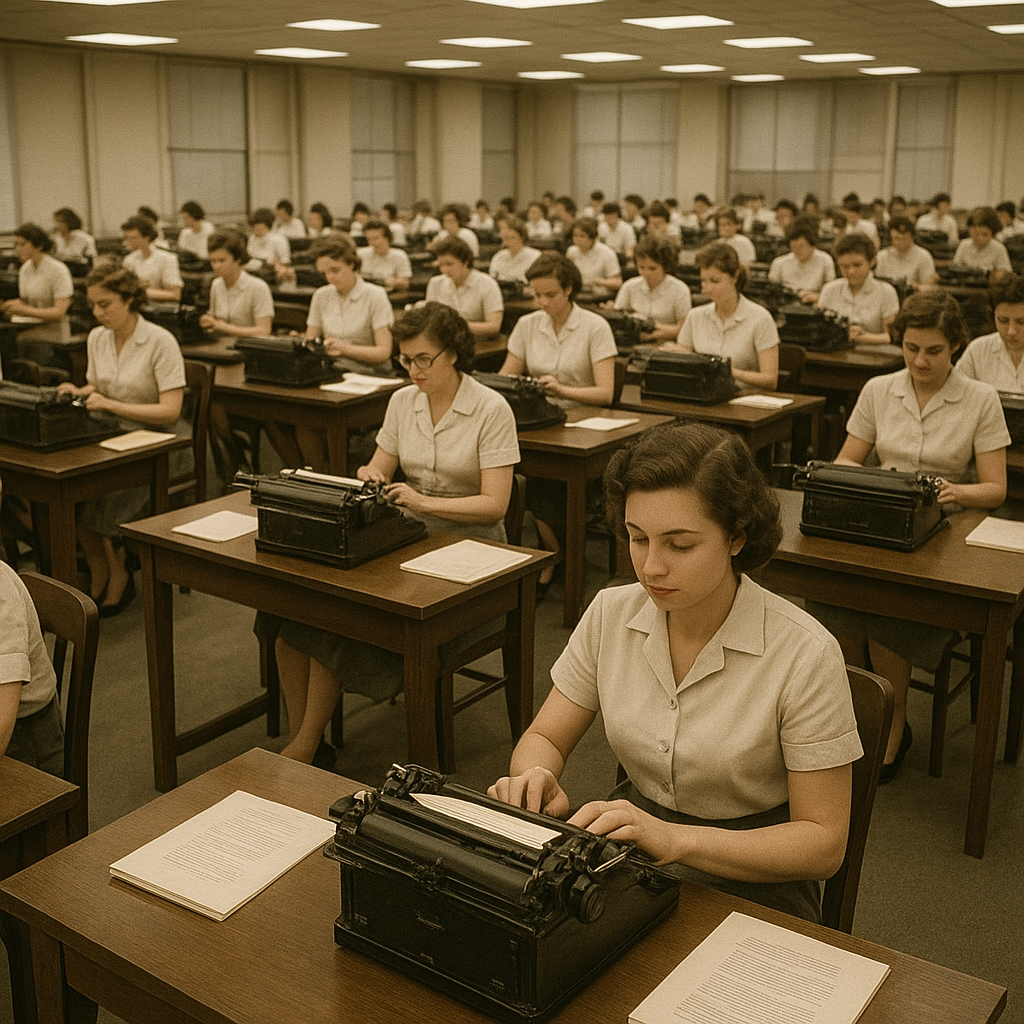
Picture this: It's 1975. Rows upon rows of workers sit at desks, fingers flying across typewriter keys, transforming handwritten notes into crisp, typed documents. The typing pool - a fixture of every major corporation. Fast forward to 1995. Those typing pools? Gone. But here's what nobody predicted: the workers weren't gone. They'd become database administrators, spreadsheet wizards, customer service specialists, and IT support professionals.
Today, as AI transforms our workplace at breathtaking speed, we're hearing the same fears we heard when personal computers arrived: "Machines will replace us all." But history - and the data - suggest something far more optimistic for those willing to adapt.
Technology doesn't replace human work - it transforms it. The PC revolution destroyed 3.5 million jobs but created over 19 million new ones. AI is following the same pattern, and workers who adapt are already earning 56% more than those who don't.
The Pattern We've Seen Before
Let me share some numbers that might surprise you. When personal computers revolutionized offices in the 1980s and 90s, yes, we lost about 3.5 million jobs - typists, filing clerks, telephone operators. But here's what happened next: we created over 19 million new jobs. That's a net gain of 15.8 million positions. Today, roughly 10% of the American workforce holds jobs that didn't exist before the PC revolution.
Think about that for a moment. We didn't just shuffle people around. We created entirely new industries, new possibilities, new ways of adding value.
Technology Transitions and Job Creation
The Industrial Revolution
Machines replaced manual craftsmen and home weavers. But factories created millions of new manufacturing, maintenance, and management jobs.
Net: Millions of new factory jobsThe Typing Pool Era
Centralized pools of typists processed all corporate correspondence. Millions employed in repetitive document production roles.
Peak: 3.5M clerical workersThe PC Revolution
Personal computers eliminated typing pools, filing clerks, and telephone operators. But the digital transformation spawned entirely new industries.
Lost: ~3.5M jobsCreated: 19M+ new jobs
The Internet Age
E-commerce disrupted retail. But web developers, digital marketers, social media managers, UX designers, and data analysts emerged as entirely new careers.
10% of workforce in new digital rolesThe AI Transformation
AI is automating repetitive tasks while creating new roles: AI trainers, prompt engineers, AI ethics officers, and human-AI collaboration specialists.
56% wage premium for AI-skilled workersThe Transformation Pattern: The typing pool workers didn't disappear - they evolved. The woman who once typed executives' memos became the one managing complex databases. The man who operated calculating machines became a financial analyst building sophisticated Excel models. They learned to use tools that amplified their capabilities rather than replacing them.
Jobs Destroyed vs. Jobs Created
Every major technological shift has followed the same pattern - short-term displacement followed by far greater long-term job creation.
AI: Your New Power Tool for Repetitive Tasks
Here's what's actually happening in workplaces today: AI isn't replacing workers wholesale - it's taking over the repetitive, mundane tasks that drain our energy and creativity. Think about the parts of your job that feel like groundhog day:
These are AI's sweet spot - repetitive tasks that follow patterns but don't require deep creativity or complex human judgment. And here's the key insight: when AI handles these tasks, it doesn't eliminate your job. It transforms it.
Real-World Transformation: Consider what's happening in HR departments across the country. Professionals who used to spend 15 hours a week screening resumes and writing initial candidate emails now use AI to handle the first pass, flagging qualified candidates and drafting initial outreach.
Those 15 hours? They're now spent actually talking to candidates, building relationships, and making nuanced hiring decisions that consider team dynamics and company culture - things AI can't do.
The accountant who once spent days on data entry now focuses on strategic financial planning. The marketing coordinator who drafted dozens of similar social media posts now develops creative campaigns. The customer service rep who answered the same five questions hundreds of times now handles complex problem-solving that requires empathy and judgment.
“AI doesn't replace the worker - it replaces the repetitive. What remains is the remarkable: creativity, strategy, empathy, and judgment.
The 56% Advantage: Why Adaptation Pays Off Now
Here's a statistic that should grab your attention: Workers with AI skills are earning 56% more than those without them in 2025. That's not a typo. Fifty-six percent. And it's doubled from just last year.
But here's the encouraging part - these aren't all programmers or data scientists. They're regular professionals who learned one fundamental skill: how to collaborate with AI effectively. They learned to "manage up" to their AI assistant, treating it like a brilliant but very literal intern who needs clear instructions.
The Hiring Reality: Companies aren't just paying more for AI skills - they're hiring more. Recent data shows that 91% of companies using AI are actually increasing their headcount. Why? Because when workers are freed from repetitive tasks, they can focus on innovation, relationship-building, and complex problem-solving. That creates value. That drives growth. That creates new opportunities.
Don't Wait: The wage gap between AI-skilled and non-AI-skilled workers is growing rapidly. In 2023, the premium was roughly 28%. By 2025, it has more than doubled to 56%. The longer you wait to build these skills, the wider the gap becomes.
Your Adaptation Playbook: Start Simple
If you're thinking "This sounds great, but I'm not technical," there's good news: you don't need to be. Remember, most people who thrived in the PC revolution weren't computer scientists. They were regular workers who learned to use new tools.
The key is to start with the repetitive tasks in your current role. Ask yourself:
Identify Patterns
What do I do every day that follows a predictable pattern? These are your automation candidates.
Spot Copy-Paste Workflows
What tasks feel like copying and pasting with small variations? AI excels at templated work.
Reclaim Strategic Time
Where do I spend time on routine work instead of strategic thinking? That's where AI frees you up.
Start Learning Today
Pick a free resource and spend just 15 minutes. That's all it takes to begin your AI journey.
Two Excellent Resources to Begin Your Journey
- AI Tutorial Course for Beginners - Start here if you've never worked with AI. It's interactive, jargon-free, and designed for absolute beginners.
- Claude for Work - Perfect for learning how to apply AI to real workplace tasks, from email writing to data analysis.
Both are free. Both assume zero technical background. Pick one and spend 15 minutes with it today. That's all it takes to start.
The Skills That Make You Irreplaceable
While AI excels at repetitive tasks, here's what it can't do - and what makes you valuable:
Complex Problem-Solving
AI can identify patterns, but you understand context. When a client is upset, AI can draft an apology email, but you know whether that client needs acknowledgment, action, or maybe just someone to listen.
Creativity and Innovation
AI can generate variations on existing ideas, but breakthrough innovation is human territory. AI would never have invented the iPhone - it would have just made better flip phones.
Emotional Intelligence
AI can recognize sentiment in text, but it can't build trust, inspire a team, or know when a colleague needs encouragement versus honest feedback.
Ethical Judgment
AI can follow rules, but you navigate the gray areas where values, consequences, and human impact intersect. This is where humanity's nuance shines.
Strategic Thinking: AI can analyze data and identify trends, but you connect dots across disciplines, see around corners, and make leaps that data alone never could.
“The most valuable workers won't be those who can do what AI does. They'll be those who can do what AI can't - and use AI to amplify everything else.
The Opportunity Ahead
New roles are emerging every month: AI trainers who teach systems industry-specific knowledge. Prompt engineers who optimize AI interactions. AI-human collaboration specialists who design workflows. Digital transformation consultants who help companies integrate these tools. These jobs didn't exist three years ago.
But more importantly, existing jobs are becoming more interesting. Teachers spend less time grading and more time actually teaching. Doctors spend less time on paperwork and more time with patients. Designers spend less time on revisions and more time on creative concepts.
The Evolution of the Worker
The Pattern Is Clear: AI handles the repetitive so humans can focus on the remarkable.
Your Move
The typing pool workers of the 1970s couldn't have imagined becoming database administrators, web designers, or IT specialists. They couldn't have pictured a world where everyone would have a computer more powerful than room-sized mainframes sitting on their desk.
Similarly, we can't fully imagine all the jobs that will exist in 10 years. But we can see the pattern. Technology doesn't replace human work - it transforms it. The question isn't whether AI will change your job. It will. The question is whether you'll be ready to change with it.
The workers who thrived after the PC revolution weren't necessarily the youngest or the most technical. They were the ones who started learning early, who saw tools instead of threats, who adapted instead of resisted.
That 56% wage premium for AI-skilled workers? It's happening right now. While others debate whether AI will take jobs, be the one learning to work with AI. Focus on the repetitive tasks that bog you down. Learn to delegate them to AI. Free yourself for the work that matters - the creative, the strategic, the deeply human.
The Future Belongs to Humans Who Know How to Make AI Work for Them.
Start today. Open one of those tutorials. Practice for 15 minutes. Your future self will thank you.
The choice is yours: Watch the transformation happen, or be part of shaping it. History shows us that those who choose to shape it don't just survive - they thrive.
Ready to Build Your AI Skills?
Strongly makes it easy to integrate AI into your workflows with enterprise-grade security, governance, and support.
Schedule A DemoReferences
- McKinsey & Company. "What can history teach us about technology and jobs?" Data showing 3.5 million jobs destroyed but 19+ million created through personal computer and internet revolution.
- Quantum Zeitgeist. (2025). "The Relentless March Of Automation: From Typing Pools To Artificial Intelligence". Historical analysis of typing pool evolution.
- PwC. (2025). "Global AI Jobs Barometer 2025". 56% average wage premium for AI-skilled workers in 2024.
- World Economic Forum. (2025). "How to support human-AI collaboration in the Intelligent Age". 82% of middle-skill jobs now require digital proficiency.
- AIPRM. (2024). "AI Replacing Jobs Statistics 2024". 91% of companies using AI will hire new employees in 2025.
- OpenAI. "Expanding economic opportunity with AI". Studies show AI-savvy workers are more productive and earn more.